Pretty catchy title, eh? I figured that would draw you suckers in. In all seriousness, I've been intending and inspired to bang out this column/post/steaming heap of whimsy for awhile, for two reasons:
1. The idea came to me a year or so ago when Bob Ryan wrote about all the cool and obscure games and moments recorded in his scorebook. I thought it was an unusual piece for a famous columnist to write, an unabashedly and admirably dorky tribute to baseball and his job; I loved it. If anyone needs an example of how Ryan retains his passion and popularity after all these years in the business,
here you go.
2. I took my daughter, age 3 1/2, to her first Sea Dogs game recently. She loved it as much as her old dad hoped she would, though for some reason she was more thrilled by the Trash Monster and the ice cream-in-a-helmet than she was by seeing Michael Bowden or Jed Lowrie. Go figure. I do think she is ready for her inaugural trip to Fenway next year, and the thought of watching her blue eyes widen as she comes up the ramp . . . well, can you blame me if that got me to reminiscing about
my first visit to Fenway and the dozens to follow? Of course not, at least if you have a sentimental bone in your body. So it seems only appropriate to start this thing with . . .
April 21, 1978: Red Sox 9, Indians 7 . . . my first Fenway foray, and yes, all the sappy cliches about a kid's first visit to Updike's lyric little bandbox apply. The grass
was the most gorgeous shade of green I'd ever seen. The Monster
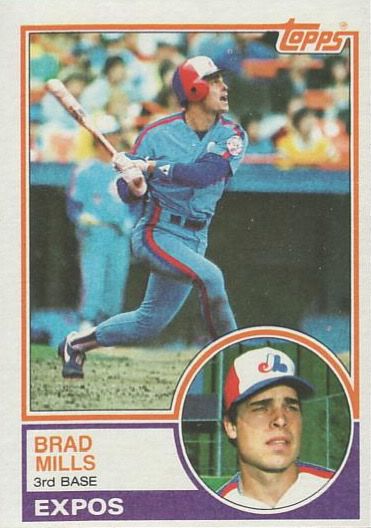
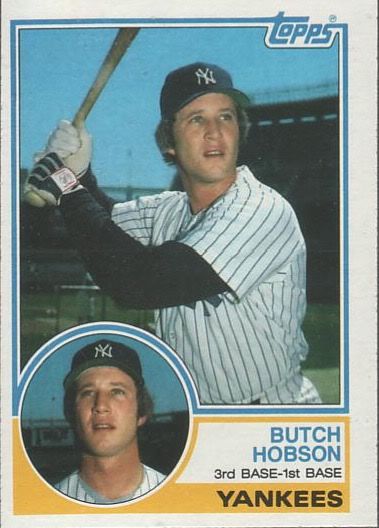
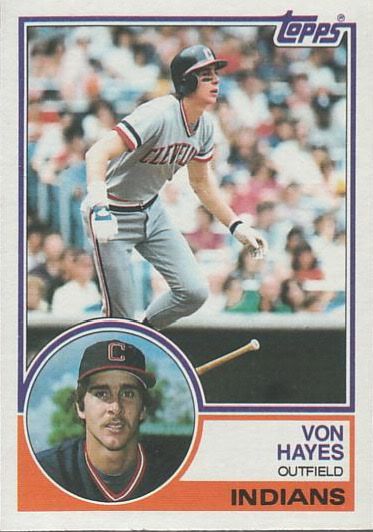
was so much more imposing and than it looked on TV. But the thing that really blew my 8-year-old mind was watching my baseball cards come to life.
Holy crap, Butch Hobson is playing third base right in front of me! . . . Wow, Andre Thornton is a giant! . . . I can't believe that's really Jim Rice over there! . . . Hey, there's Rick Manning - he swiped the Eck's wife! Okay, maybe not that last one, but you get the gist. I went to the game with my parents and my Uncle Dennis and his kids, whom we were visiting for a week at their home near White Horse Beach in Plymouth, Mass. All these years later, I still remember that as one of the best times of my childhood.
Sept. 26, 1982: Yankees 6, Red Sox 2My parents made the unfortunate decision to buy bleacher seats for this one, and you know how, er, "smoky" the bleachers could be in those days. Let's just say I'm pretty sure that was my first experience with a contact high, and coupled with that particular afternoon's stifling heat, it's really no surprise I barfed up my Klondike bar and coke sometime in the late innings. My deep-fried mind somehow retained a couple scattered snapshots from the game - the rifle-shot pop of the mitt as Goose Gossage warmed up in front of us, a fine catch by the otherwise forgettable Reid Nichols, the shocking improbability of seeing Dewey Evans drop a fly ball (maybe he got a whiff of what was going on in the bleachers behind him). But most of my memories came postgame, when, sufficiently recovered from the Klondike Incident (sounds like the name of a Guns 'N' Roses album), I talked my folks into letting me over around outside the players' parking lot in hopes of getting an autograph or two or, better yet, 20. How'd that go, you ask? About as well as the oppressive-heat-and-weed-smoke combo in the bleachers, thanks. Naive as I was at 12, I had these visions of Dewey, The Eck, Jim Ed, Yaz and so on shaking hands, signing endless autographs and generally acting like the larger-than-life, super-swell heroes I believed them to be. Instead, I got see Bob Stanley - who, much to my surprise, was as bald as a baseball without his cap on - sitting on the hood of his car drinking a beer and mockingly waving at the fans. I got to see all the fancy stars drive by obliviously by in their fancy cars, refusing even to make eye contact. I got to watch Mike Torrez, shirt unbuttoned to his waist and reeking of what must have been a prototype for Sex Panther, pull over and sign an old newspaper for a homeless-looking guy (probably a sports writer), but ignoring me and all the pleading, pestering kids. And I got my toes run over by Eckersley, which to that point was the highlight of my day since it didn't shatter any metatarsals, or even hurt, really. (Again, no doubt due to the lingering effects from the bleachers). So yeah, it wasn't quite what I'd imagined - hell, even
Ed Jurak blew us off. But just as my parents were getting ready to drag my dejected, woozy butt home, one player, driving a considerably less flashy car than most of his teammates, pulled over. Since he didn't look like anyone I'd seen on a baseball card, I improvised, grabbing a blank piece of paper and pen my mom pulled from her purse and handed it through the driver's side window. The paper came back marked with a signature crisp and clear:
Brian Denman. I had no clue who he was then, but you can be sure I was cheering him on the second-to-last day of the season, when he pitched
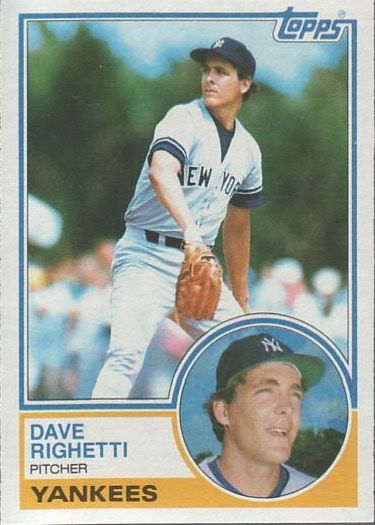
a 5-0 shutout over those same Yankees. I was convinced he was going to be the Red Sox equivalent to the pitcher he beat that day, young New York ace Dave Righetti, but it turned out that shutout was Denman's last appearance in a big-league uniform. I hope he realizes that someone remembers him well.
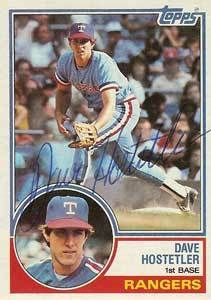 April 17, 1983: Rangers 1, Red Sox 0, 14 innings
The Rangers had a young first baseman named
Dave Hostetler, who'd had some success as a rookie in '82, hitting 22 homers and finishing sixth in the AL rookie of the year voting. But Sox starter John Tudor and the Sox bullpen exposed the kid's fatal flaw on this night, striking him out four times on nothing but breaking balls. (Somewhere, Wily Mo Pena nods knowingly.) Hostetler looked like he didn't belong in the big leagues, and after whiffing 103 times in 304 at-bats that season, his career
was over with the exception of a cameo here and there. Other skewed recollections: Sox shortstop
Glenn Hoffman proved he didn't have his
kid brother's command, airmailing the catcher on a relay as the lone run scored in the 14th, and my mom spilled her annual beer on her purse, drenching my brand-new Topps '83 Red Sox team set. There may or may not have been a tantrum on the ride home.
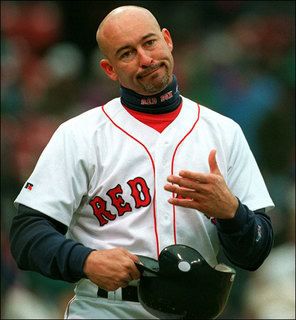
April 11, 1996: Twins 6, Red Sox 5This one might be the best time I've ever had at the ballpark, in part because of some weird scheduling circumstances and in part because of the crowd-pleasing antics of a goofball we all knew as "Greenie." The specifics about the scheduling stuff have escaped my memory and Google was of no help. I recall there being a huge snowstorm the day before and everyone assuming this game would be called off . . . and then Mother Nature pulling yet another a fast one on us New Englanders and delivering an absolutely glorious spring day. On a whim, me and a few buddies from Concord hopped in the car, headed the hour south, bought tix when we got there (yes, that used to be possible, kiddies), and joined about 4,000 other fans in watching Clemens duel Radke. The coolest part? Because the crowd was so sparse, the Sox let fans sit wherever they wanted. The four of us sat in the first row in the shadow of the Monster, where my leather-lunged buddy spent the early innings good-naturedly hassling Sox left fielder
Mike Greenwell. Because we were so close and the park was so empty, Greenwell heard every word, smirking and glancing over with a bemused look every now and then, a great sport about the whole thing. Well, fast forward to the middle innings. Greenwell, whose power was mostly a rumor at this point, smacks a home run. Upon returning to his position at the end of the inning, he takes a detour toward our seats, where everyone in the vicinity is yelling "Greenie!" and giving him a standing ovation. Greenwell, without saying a thing, saunters up in front of my buddy, doffs his cap, and bows exaggeratedly like he's a Broadway star on opening night. Talk about getting the last word. After that day, Greenie was forever okay in my book.
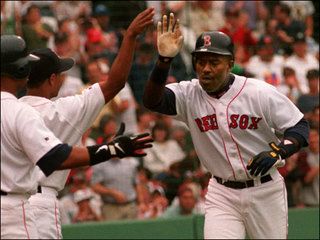 June 16, 1996: Red Sox 10, Rangers 9Reggie Jefferson
 wallops a walkoff off Mike Henneman over the Monster as the Sox come back from a 9-3 seventh-inning deficit. Jefferson couldn't hit lefties with Bea Arthur's bat, but he was a more productive stick than you probably remember (.347-19-74 in '97, for instance), and had he not left the team in a huff after he was left off the ALDS roster in '99, he might have made a difference in the ALCS against the Yankees. Hell, he couldn't have been worse than Huskey and Hatteberg. I wonder if he regrets how it all played out; after skipping out on the Sox, he never played in the majors again.
Sept. 21, 2000: Red Sox 9, Indians 8By the time my girlfriend (now Mrs. TATB) and I found parking and made our way to our seats, the repulsive
Rolando Arrojo had put the Sox in a 7-0 hole in the second inning. Little did we know that while we were futilely driving up and down Boylston, Darren Lewis was trying (and failing) to punch some sense into Carl Everett in the Sox clubhouse. God, those Sox teams were despicable, weren't they? Stunningly,
Steve Ontiveros - Dan Duquette's most ill-conceived reclamation project, which is quite a legacy - pitched well in relief, the Sox rallied thanks to a Troy O'Leary homer (not the first time he tormented the Tribe), and they had one of their final feel-good moments of a lost season.
Sept. 16, 2002: Indians 7, Red Sox 1Better known as Grady's White Flag. This was the second game of a doubleheader, and while
the Sox still had a slim chance in the wild card race, Sox manager Grady Little decided this would be a fine time to make his surrender official. Check out this lineup Gump ran out there with the season hanging by a thread:
Rickey Henderson, LF; Johnny Damon, CF; Benny Agbayani, RF; Carlos Baerga, DH; Shane Andrews, 3B; Doug Mirabelli, C; Tony Clark, 1B; Rey Sanchez, SS; Freddy Sanchez, 2B. By my accounting, he rested Nomar, Manny, Shea Hillenbrand, Cliff Floyd, Brian Daubach, Jason Varitek, and Trot Nixon in Game 2. Granted, a couple of the regulars (Floyd, Nixon, Dauber) sat because they were facing a lefty, Cleveland rookie Brian Tallet . . . but c'mon, it's hardly Guidry-in-'78 we were talking about here, it was Brian Freaking Tallet, winner of five games since. But facing Pawtucket's finest, he shut out the Sox on four hits in six innings. What a joke. Once it started raining (surely the work of the baseball gods infuriated by Grady's lineup card), I left, the first time I'd departed Fenway before a game had ended. If Grady could give up prematurely, hell, so could I.
Sept. 16, 2003: Red Sox 3, Devil Rays 2This is the only time I saw Pedro pitch in person with my dad. I don't remember a whole lot about Pedro's performance except that it was somewhat meaningful given that the Sox were in the midst of a playoff push. But I won't forget this: After Pedro brought down the house and by whiffing a D-Ray (probably Lugo) to escape a late jam, my dad wore a look of pure joy, like there was no place he'd rather be. Just one of those things that sticks with a son, I guess.
Game 3, 2003 ALCS: Rich Harden delivers. Trot Nixon swings. Pandemonium. I'm assuming you need no further detail than that. I suppose it's worth noting that this is the only one on this list that I covered as a reporter. Me being me and all, I realized to my horror the next morning that I left the score out of my column. If not for that, the Pulitzer was mine, I just know it.
* * *
Well, this ended up a little longer than I thought it would be. (
That's what she said!) Thanks for reading this far and humoring me. My memory is pretty good for this stuff, I think, but it was obviously jogged with the assistance of baseball-reference.com, so I must tip my hat, Greenwell-style, to Sean Forman's truly invaluable creation. And, please, drop me an email or post your favorite random Fenway memories in the comments. I'd love to hear 'em, even if they also involve puking in the bleachers.
Labels: Brian Denman, Butch Hobson, Dave Hostetler, Dennis Eckersley, Ed Jurak, Grady Little, Mike Greenwell, Reggie Jefferson, Steve Ontiveros, Troy O'Leary

 If you came here this morning expecting some sort of semi-coherent preview on the Sox/Angels series, you can find my best attempt at that over here. Gotta push the paying gig first, peeps.